
You filed your taxes. You hit “Submit.” You did a little victory dance. And now, you are engaged in the great American pastime of refreshing the IRS “Where’s My Refund” tool every four hours.
We know the feeling. It’s like tracking a package, except instead of a pair of shoes, it’s your own money, and the delivery driver is a giant government bureaucracy that still uses fax machines.
The status bar on that website can be maddeningly vague. What does “Received” really mean? Why is it stuck? Is “Topic 152” a secret code for “we are auditing you”?
We dug into the manual (and the new 2025 laws) to translate IRS-speak into human English. Here is exactly what is happening to your money while you wait.
The Three Bars of Destiny
The “Where’s My Refund” tool (WMR) is visually simple, just three little bars. But the gap between them can feel like an eternity.
Bar 1: Return Received
What it says: “We have your tax return.”
What it means: “You exist.”
Getting this status means you passed the first hurdle: The IRS computer recognized your name, Social Security Number, and basic math. It accepted the file into its digital fortress.
Do not confuse “Received” with “Approved.” They haven’t actually looked at your deductions yet. They just acknowledged you filed paperwork. It’s like a teacher collecting your homework. They haven’t graded it, they just put it in the pile.
Bar 2: Refund Approved
What it says: “We are processing your refund.”
What it means: “You won.”
This is the holy grail. It means a human (or a very smart robot) looked at your return, agreed with your math, accepted your deductions, and authorized the Treasury to cut a check.
This step might take longer in 2026. Because the One Big Beautiful Bill Act (OBBBA) created brand new deductions for Overtime and Tips, the IRS has dialed up its fraud filters. They are double-checking these new claims against your W-2s. If you claimed these, expect to hang out between Bar 1 and Bar 2 for a while.
Bar 3: Refund Sent
What it says: “We sent your money.”
What it means: “It’s out of our hands.”
The IRS has released the funds. If you chose Direct Deposit, check your bank. If you chose a paper check, watch your mailbox.
If this bar lights up but your bank account is empty, wait 5 days. Banks love to hold onto government money for a “processing period” just to annoy you.
The “PATH Act” Hold: Why Early Filers Get Punished
Did you file in January? Did you claim the Earned Income Tax Credit (EITC) or the Child Tax Credit (CTC)?
If yes, you are legally stuck in limbo.
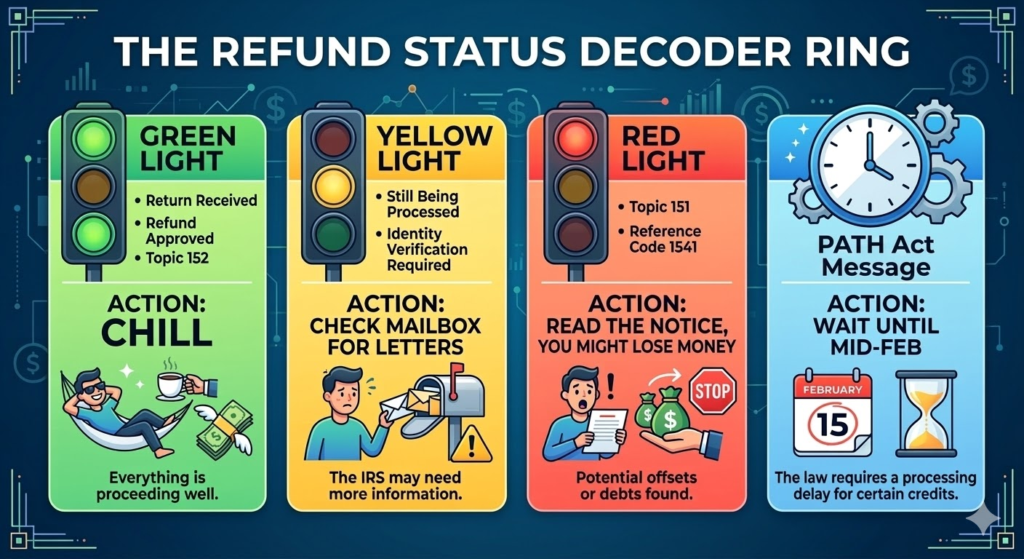
A federal law called the PATH Act actually forbids the IRS from issuing refunds for these credits before mid-February. It’s an anti-fraud measure designed to stop identity thieves from filing fake returns before the real you can.
You will likely see a generic message about the PATH Act or “processing.” Your return isn’t broken. It’s just in a “time out” until the calendar hits February 15th. No amount of refreshing the page will change this.
Decoding the “Purgatory” Messages
Sometimes the bars disappear entirely, replaced by cryptic text. This is usually when panic sets in. Let’s translate the most common ones.
“Still Being Processed” (The Vague One)
This usually means your return got pulled for a manual review. It doesn’t necessarily mean you are being audited. It often just means a computer flagged something small. Maybe a typo on a Social Security Number or a math error on your Car Loan Interest Deduction.
You don’t have to do anything. Just wait for a human to look at it.
“Topic 152” (The Generic One)
This represents a generic disclaimer. It links to a page that basically says, “We try to issue refunds in 21 days, but sometimes things happen.”
If you see Topic 152, your return is likely proceeding normally, just slowly. It’s the “elevator music” of status codes.
“Topic 151” (The Bad One)
This refers to an offset. It means the IRS found a debt you owe, and they are taking your refund to pay it.
Common triggers include unpaid child support, defaulted student loans, or back taxes from previous years.
You will get a letter explaining exactly who took your money and why. You might get a partial refund if there is anything left over.
Get more articles like this straight to your inbox 
The “21-Day” Myth
The IRS loves to say that “90% of refunds are issued in less than 21 days.” While historically true, don’t set your watch by it this year.
The 2025 tax year is a “Transition Year.” The OBBBA changed the rules for 1099-K reporting, Standard Deductions, and huge income adjustments like the Overtime Deduction.
Whenever the rules change, the IRS computers get confused. They flag more returns for review. They send more “Please Verify Your Identity” letters.
Treat “21 days” as a suggestion, not a promise. If it takes 30 or 40 days, you are statistically normal for 2026.
When to Actually Check (Stop Obsessing)
Here is a fun fact to save your sanity: The “Where’s My Refund” tool only updates once a day, usually overnight.
Checking it at 10:00 AM, 10:15 AM, and 10:30 AM is pointless. It will not change.
Many returns are on a “weekly” processing cycle. For these folks, the system typically updates massively on Saturdays. If you check on a Friday and nothing has changed, wait until Saturday morning. That is the magic window.
Patience is a Profit Strategy
Waiting for a refund feels powerless. But remember, status updates are good news. Even a “delay” message means your return is in the system and hasn’t been lost in the ether.
The delays this year are the price we pay for the new OBBBA perks. The government is giving us $25,000 overtime deductions and tax-free tips. In exchange, they are taking a few extra weeks to make sure we aren’t lying about it.
It’s a fair trade. Let them take their time. As long as that “Refund Approved” bar eventually lights up, the wait is worth it.